August 27, 2026
⋅
3
min read


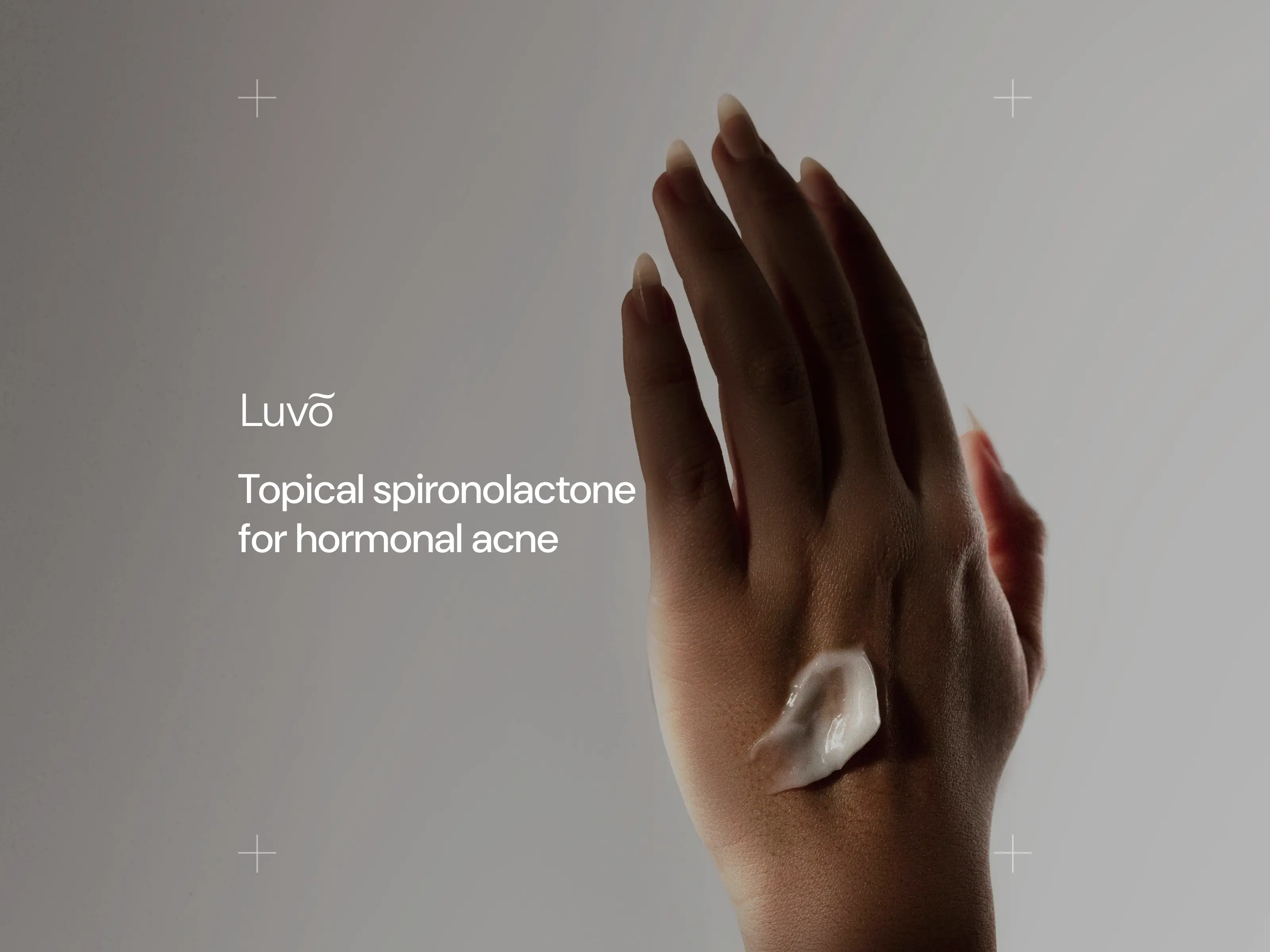
Adult acne, especially in women, often has a hormonal pattern, even when a standard blood panel comes back "normal." That is because the issue is frequently not how much androgen hormone is circulating, but how sensitive your oil glands are to it. Spironolactone works on exactly that sensitivity, and it comes in two very different forms: an oral pill and a topical cream or gel.
This guide explains how to recognize hormonal acne, what topical spironolactone actually does, what the research does and does not show, and how the topical form differs from the pills. It is educational content, not medical advice, and not a diagnosis.
A few patterns show up more often with hormonal acne, though no single one confirms it:
Any of these can also have other causes, which is why they are a reason to talk with a provider, not a basis for self-diagnosis.
Spironolactone blocks androgen receptors, the docking sites for male-pattern hormones that are present in the female body too, including in the skin. Androgens stimulate oil (sebaceous) glands, and more sebum feeds the bacteria and inflammation behind acne. By reducing that stimulation, spironolactone lowers sebum output, which is why it is used for the oily, deep, cyclical breakouts that tend to read as hormonal.
That underlying mechanism is the same whether the drug is taken as a pill or applied to the skin. What differs, a great deal, is how much of it reaches the rest of your body and how strong the evidence is for each route.
Oral spironolactone has been used off-label for hormonal acne for decades and has a substantial evidence base in women. It is well established in dermatology practice, even though it was originally developed as a blood-pressure and fluid medication.
Topical spironolactone, a cream or gel applied to the skin, is a newer and much less studied idea. The appeal is straightforward: deliver the anti-androgen effect where acne actually happens, in the skin, while keeping whole-body exposure low. But the evidence base for it is genuinely thinner than for the oral form, and that is worth being upfront about rather than glossing over.
Here is what the studies on topical spironolactone actually found, and where they fall short.
Small randomized trials have reported benefit. In a double-blind randomized trial of 78 people with mild-to-moderate acne, 5% topical spironolactone gel reduced the total lesion count significantly more than placebo over eight weeks (p = 0.007), although the difference on a broader acne severity index did not reach statistical significance (p = 0.052) [1]. A later pilot study applied 5% spironolactone cream twice daily for eight weeks and reported reductions in comedones and inflammatory papules in both male and female participants, with a good tolerability profile, but it enrolled only 15 people [2].
Pooling the evidence tells the same story. A 2025 meta-analysis of oral and topical spironolactone for acne found that topical 5% spironolactone reduced total lesion count and acne severity versus placebo with a good safety profile, while explicitly noting that only a small number of eligible studies exist and that larger, higher-quality randomized trials are still needed [3].
So the honest summary is this: there is a plausible mechanism and some positive early signals, but the topical evidence rests on small, short studies with mixed results on some measures. That is a meaningfully weaker foundation than the decades of data behind oral spironolactone. Anyone marketing topical spironolactone as an established, proven acne cure is getting ahead of what the research currently supports, and setting expectations honestly is part of using it sensibly.
If oral spironolactone has more evidence, why consider the topical form at all? The trade-off is systemic exposure.
Oral spironolactone circulates through the whole body. Because it is potassium-sparing, it can raise blood potassium, and it interacts with kidney function and with other medications that affect potassium. That is why a provider takes a careful history and, for some patients, considers monitoring before and during oral use. Oral spironolactone is also generally avoided in pregnancy and is typically not used to treat acne in men, because of its systemic anti-androgen effects.
Topical spironolactone is designed to act locally, and absorption through the skin is generally reported as low, which is the main reason it is studied as a gentler alternative [2]. Low, though, is not the same as zero. That is exactly why the choice between topical and oral, and whether either is appropriate at all, is a provider decision based on your full history, including anything involving kidney function or medications that affect potassium.
Topical spironolactone is not an off-the-shelf product. Because there is no standard FDA-approved topical spironolactone, it is prepared by a compounding pharmacy, often as a topical spironolactone cream that pairs it with a barrier-supporting ingredient such as niacinamide. Compounded combinations are not FDA-approved as combinations, and the FDA does not evaluate compounded medications for safety, effectiveness, or quality. The individual ingredients are well characterized, but the combined product does not carry its own FDA approval.
Getting it is a provider-led process, not a checkout. With a telehealth service like Luvo, you complete a short intake questionnaire about your skin and history, and you can indicate the formula you are interested in, such as the hormonal acne formula. A licensed provider then reviews your information and decides whether topical spironolactone is appropriate, or whether a different approach fits better. Your selection is a starting point for that review, not a purchase, and nothing is prescribed or shipped without the provider's approval.
Topical spironolactone is most often considered by adults whose acne fits the hormonal pattern described above, particularly along the jawline and chin, and who want to target oil production rather than only treat the surface.
It is not for everyone. It is avoided in pregnancy, while trying to conceive, and while breastfeeding, unless a provider specifically directs otherwise. People with kidney conditions, or who take medications or supplements that affect potassium, need that flagged in their history. And because the topical evidence is limited, a provider may reasonably suggest a better-studied option first, such as a topical retinoid; our explainer on tretinoin covers that route. Whether topical spironolactone fits you is a clinical decision, not a self-assessment.
How long until my skin looks different?
In the small studies available, changes were measured over about eight weeks of consistent use [1,2], and improvement is gradual rather than immediate. Results vary a lot from person to person, and some people see little change, which is one reason a provider follows up rather than treating it as set-and-forget.
Does topical spironolactone affect hormones systemically?
The intent of the topical form is to act on the skin's androgen receptors locally while keeping whole-body exposure low, and absorption through the skin is generally reported as low [2]. Low is not zero, though, so it is not a reason to skip sharing your full medical history with a provider.
Can men use it?
Oral spironolactone is generally not used to treat acne in men because of its systemic anti-androgen effects. Topical spironolactone has been studied in both men and women, precisely because its systemic exposure is lower [2]. Whether it is appropriate for you specifically is still a provider decision.
Do I need blood tests before starting?
Luvo does not run lab tests. Routine potassium monitoring is generally associated with oral spironolactone rather than the low-absorption topical form, but if a provider decides any bloodwork is clinically relevant for you, it is arranged through your own provider or physician, not through Luvo.
Because the signs of hormonal acne overlap with other causes, and because topical spironolactone has a thinner evidence base and its own safety considerations, this is a conversation to have with a licensed provider rather than a decision to make alone. Start with a short intake, share your full history, including anything involving kidney function or potassium, and a provider will decide whether topical spironolactone, or a different approach, makes sense for you before anything is prescribed.
Explore Luvo's Skincare Program.
This article is for educational purposes only and is not medical advice. Luvo's tretinoin formulas are compounded, and compounded medications are not FDA-approved and are not evaluated by the FDA for safety, effectiveness, or quality. Individual results vary, and nothing here is a promised outcome. Always consult a licensed healthcare provider to determine whether tretinoin is right for you, and do not use tretinoin if you are pregnant or breastfeeding.