Ready to take the next step?
Find out which treatment fits your health best.
Get started
No commitment until clinician review
Cancel anytime




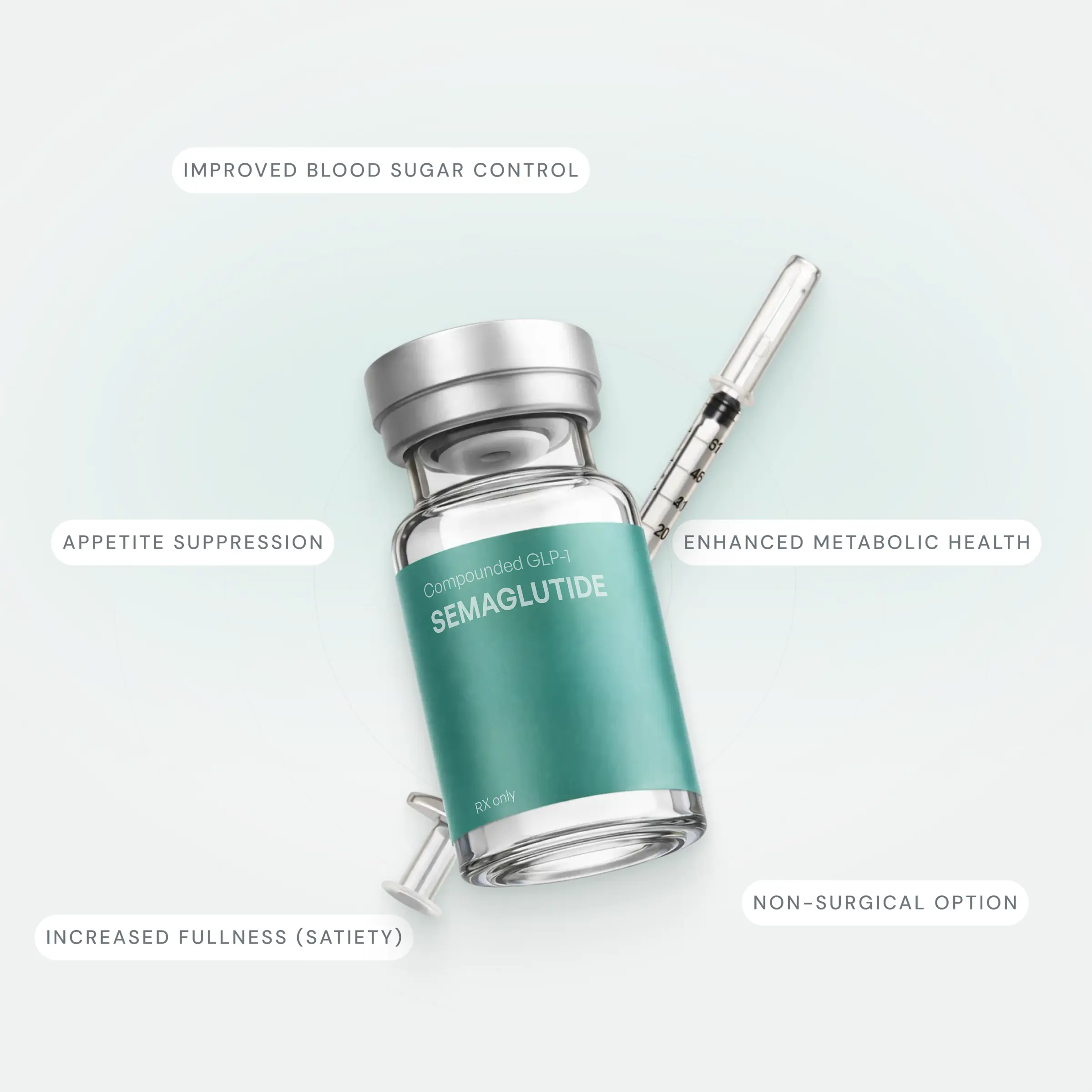

Compounded semaglutide may be prescribed as part of a clinician guided weight management program. Dosing is individualized and adjusted over time based on clinical response and tolerability. Medication is shipped if prescribed.
Semaglutide (GLP-1 receptor agonist) helps support appetite control and glucose regulation
Given as a subcutaneous injection, typically once weekly, as prescribed. Your clinician determines the schedule and adjusts dosing based on your response.
Like most GLP-1 medications, semaglutide can cause side effects, including:
Side effects vary by individual. Your clinician will review potential risks and how symptoms are typically managed.
Compounded semaglutide is an injectable medication prepared by a licensed pharmacy. It may be prescribed as part of a clinician-guided weight management program. Dosing is individualized based on clinical judgment, tolerability, and response.

Images are for illustrative purposes only. Individual results may vary. Compounded medications are not FDA-approved.
Semaglutide acts on GLP-1 receptors in the body. GLP-1 is a hormone involved in appetite signaling and glucose regulation.
In a clinician-guided program, these mechanisms may influence appetite and fullness for some individuals.

Images are for illustrative purposes only. Individual results may vary. Compounded medications are not FDA-approved.
After completing an intake and clinical review, and a visit if required by your state, treatment may be prescribed. If prescribed, injections are self-administered at home according to your clinician’s instructions and dosing schedule.

Images are for illustrative purposes only. Individual results may vary. Compounded medications are not FDA-approved.
Clinical studies of GLP-1 medications have shown weight reduction in some patients when used under medical supervision. Individual results vary.
* For illustrative estimate only.
** Estimates reflect ranges reported in clinical studies of GLP-1 medications. Individual results vary. Treatment, dosing, and outcomes are determined by a licensed clinician following clinical evaluation. Compounded medications are not FDA-approved.



Compounded Semaglutide is offered as part of a clinician-guided weight loss plan when appropriate. Your clinician will explain why it fits your goals and medical history.
This treatment supports the targeted biological pathway related to its indication. Your clinician will explain what to expect for your specific use case.
Use it exactly as prescribed. Follow your label instructions and your clinician’s guidance for timing, dose, and ramp-up.
Many injectable plans follow a weekly or scheduled cadence, but your exact frequency depends on your prescription.
Common sites include abdomen, thigh, or upper arm. Rotate sites and avoid irritated skin. Follow the technique in your instructions.
Your shipment typically includes the medication and required supplies noted in your plan. Contents vary by pharmacy and prescription.
Store exactly as directed on the label. Many injectables require refrigeration—do not freeze unless instructed.
Side effects vary by medication but can include nausea, GI discomfort, headache, fatigue, or injection-site irritation.
Start low and titrate as directed, stay hydrated, eat smaller meals, and avoid heavy/fatty meals early on if advised.
Follow your prescription instructions. If you’re unsure, contact your care team before taking an extra dose.
Seek urgent care for severe abdominal pain, signs of allergic reaction, persistent vomiting, dehydration, chest pain, or any severe symptoms.
Often yes. Keep it within the storage temperature range and carry it in your personal item. Ask your clinician for travel tips specific to your medication.








.webp)
.webp)