August 20, 2026
⋅
6
min read


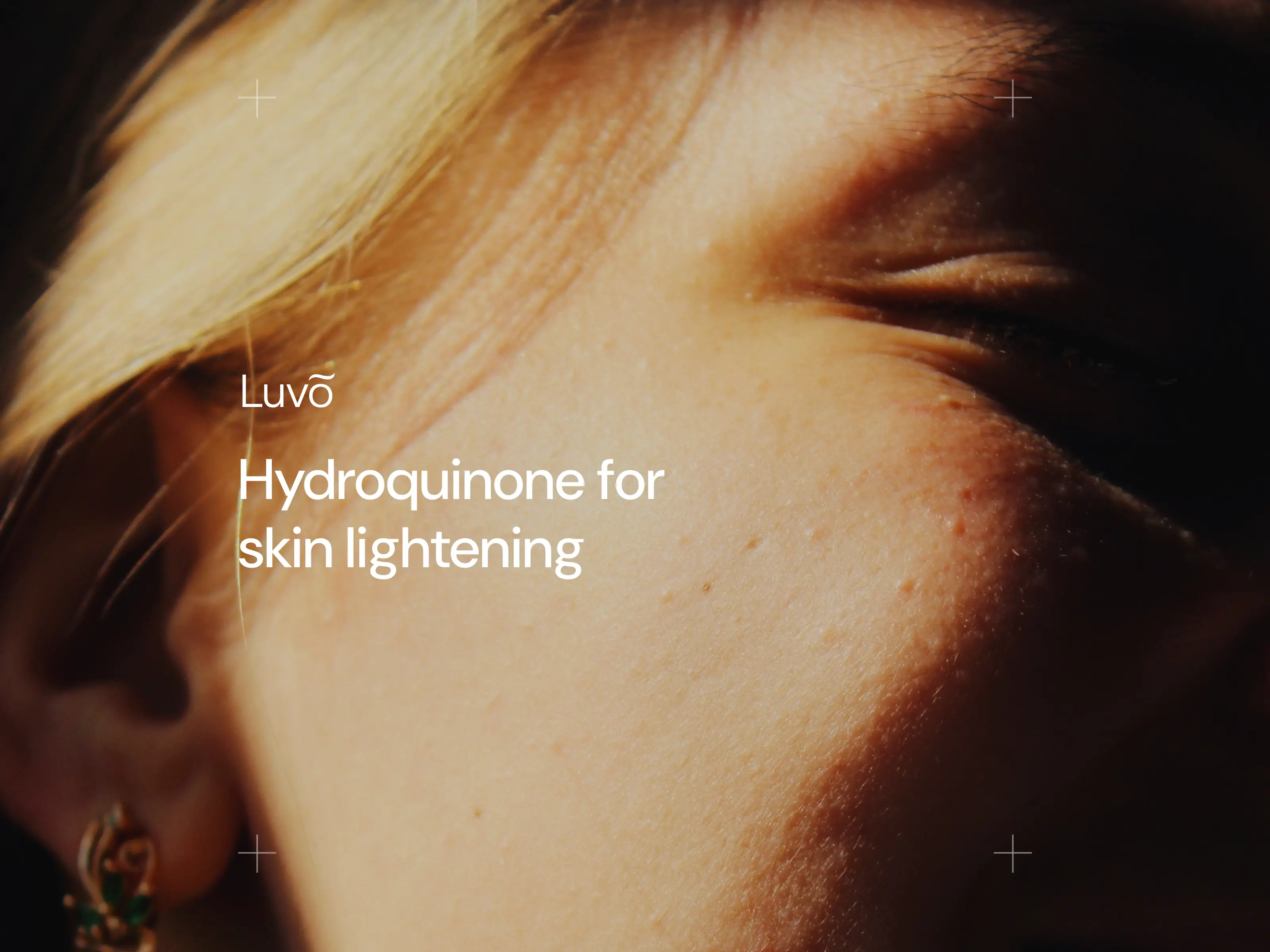
Hydroquinone is one of the oldest and most effective ingredients for treating uneven skin tone, and also one of the most tightly regulated. If you are looking into hydroquinone for skin lightening, meaning fading areas of excess pigment such as melasma, dark spots, and post-inflammatory marks rather than bleaching healthy skin, it helps to understand three things: how it actually works, what the real safety limits are, and how you can legally get it in the US today.
This article covers all three. It is educational content, not medical advice.
Hydroquinone lightens skin by interfering with melanin production. It inhibits tyrosinase, the rate-limiting enzyme your skin uses to make melanin (pigment), and it also reduces the activity of the pigment-producing cells themselves [1, 2]. Less new pigment forms in the treated area over time, which is why it is used to fade specific areas of hyperpigmentation rather than to whiten skin overall.
In dermatology, hydroquinone has long been considered the reference, or "gold standard," topical treatment for melasma and other acquired pigment problems such as solar lentigines (sun spots) and post-inflammatory hyperpigmentation [1, 2]. That track record is why it is still widely prescribed, even as newer agents like tranexamic acid, kojic acid, and azelaic acid have emerged as alternatives. This is a description of how the ingredient works, not a promised result for any individual.
For years, low-strength hydroquinone (around 2%) was sold over the counter in the US, while higher strengths needed a prescription. That changed in 2020. Under the CARES Act, the FDA determined that over-the-counter skin-lightening products containing hydroquinone are unapproved new drugs, and effective September 23, 2020, they had to be removed from the US market [3]. The FDA has stated there are no FDA-approved or legally marketed over-the-counter hydroquinone skin-lightening products, and that the only FDA-approved drug containing hydroquinone is a prescription combination for the short-term treatment of melasma [3].
The practical upshot: in the US, legitimate hydroquinone for skin lightening now runs through a licensed provider, either as that FDA-approved combination product or as a compounded prescription formula. Anything sold to you over the counter or online without a prescription sits outside that framework, which also tends to be where unregulated, over-strength "skin bleaching" products, and their risks, show up.
Hydroquinone is effective, but it has real limits that make provider oversight worthwhile.
The most discussed risk is exogenous ochronosis, a paradoxical blue-black darkening of the skin. It is uncommon, but it is associated with prolonged, unsupervised use, higher concentrations, and use without sun protection. Reported risk rises with concentrations above 4% and use beyond about three months, and it typically develops only after long-term exposure [1]. That is precisely why hydroquinone is meant to be used in defined courses under a provider's direction rather than indefinitely, and why a provider, not the person, sets the length of a course.
Two more points matter. First, treated skin becomes more sensitive to sunlight, so daily sunscreen is not a recommendation, it is part of the treatment; without it, results fade and pigment tends to return. Second, hydroquinone is generally avoided during pregnancy and breastfeeding, which is worth raising with a provider up front.
You may also see mentions of cancer risk. This traces back to older rodent studies, and a clear link to cancer in humans from topical use has not been established [1]. For most people the realistic concern is not cancer, it is misuse: too strong, too long, without sun protection, and without anyone monitoring the result.
Because standard over-the-counter hydroquinone is no longer available, the ingredient is now dispensed either as the single FDA-approved combination product or as a compounded prescription. Compounded formulas often pair hydroquinone with other actives, for example a retinoid such as tretinoin, a mild corticosteroid, or brighteners like kojic acid and niacinamide, in the tradition of the long-used "triple combination" approach for melasma.
One important line: compounded combinations are not FDA-approved as combinations, and the FDA does not evaluate compounded medications for safety, effectiveness, or quality. The individual ingredients are well characterized, but the specific compounded product does not carry its own FDA approval. If a formula includes a corticosteroid, that component is also not meant for long-term continuous use on the face, which is another reason the length of a course is set by a provider.
Since it is prescription-only, getting hydroquinone is a clinician-led process, not a purchase. With Luvo, you complete a short intake questionnaire about your skin, your history, and what you are trying to treat, and you can indicate the formula you are interested in. A licensed provider then reviews it and decides whether hydroquinone is appropriate, at what strength, and for how long, or whether a different approach, such as a tranexamic acid formula, fits you better. Your selection is a starting point for that review, not a purchase, and nothing is prescribed or shipped without the provider's approval.
Hydroquinone is most often considered for melasma, sun spots, and post-inflammatory hyperpigmentation that has not responded to gentler options. It is not for everyone. It is avoided in pregnancy and while breastfeeding, it requires strict daily sun protection, and it is intended for time-limited courses rather than open-ended daily use. People who have had irritation or unusual pigment responses to actives in the past should flag that. Whether it suits you is a provider decision, not a self-assessment.
Can I buy hydroquinone over the counter for skin lightening?
Not in the US. Since 2020, over-the-counter hydroquinone skin-lightening products have been treated as unapproved and removed from the market [3]. Legitimate access now runs through a licensed provider, as either the FDA-approved combination product or a compounded prescription.
How long can I use it?
In courses, not indefinitely. Because the risk of ochronosis and irritation rises with prolonged, high-strength, unprotected use, hydroquinone is typically used for a defined period and then paused, with the exact duration set by your provider [1].
How long until I see a difference?
It is gradual, usually over weeks to a few months, and results vary a lot from person to person. Sun exposure without protection works directly against it, which is why daily sunscreen is part of the plan rather than an optional extra.
Is it safe during pregnancy?
Hydroquinone is generally avoided during pregnancy and breastfeeding. If either applies to you, raise it with your provider, who can suggest a more appropriate approach.
Hydroquinone can be effective for the right person, but its benefit depends on using the right strength, for the right length of time, with sun protection and oversight. Start with a short intake, and a licensed provider will review your skin and history, decide whether hydroquinone is appropriate and at what concentration, and set a course, before anything is prescribed.
Explore Luvo's Skincare Program.
This article is for educational purposes only and is not medical advice. In the US, hydroquinone is available only through a licensed provider, and compounded hydroquinone formulas are not FDA-approved as combinations and are not evaluated by the FDA for safety, effectiveness, or quality. Individual results vary, and nothing here is a promised outcome. Always consult a licensed healthcare provider to determine whether hydroquinone is right for you, and do not use it during pregnancy or breastfeeding unless a provider directs otherwise.