November 3, 2026
⋅
6
min read


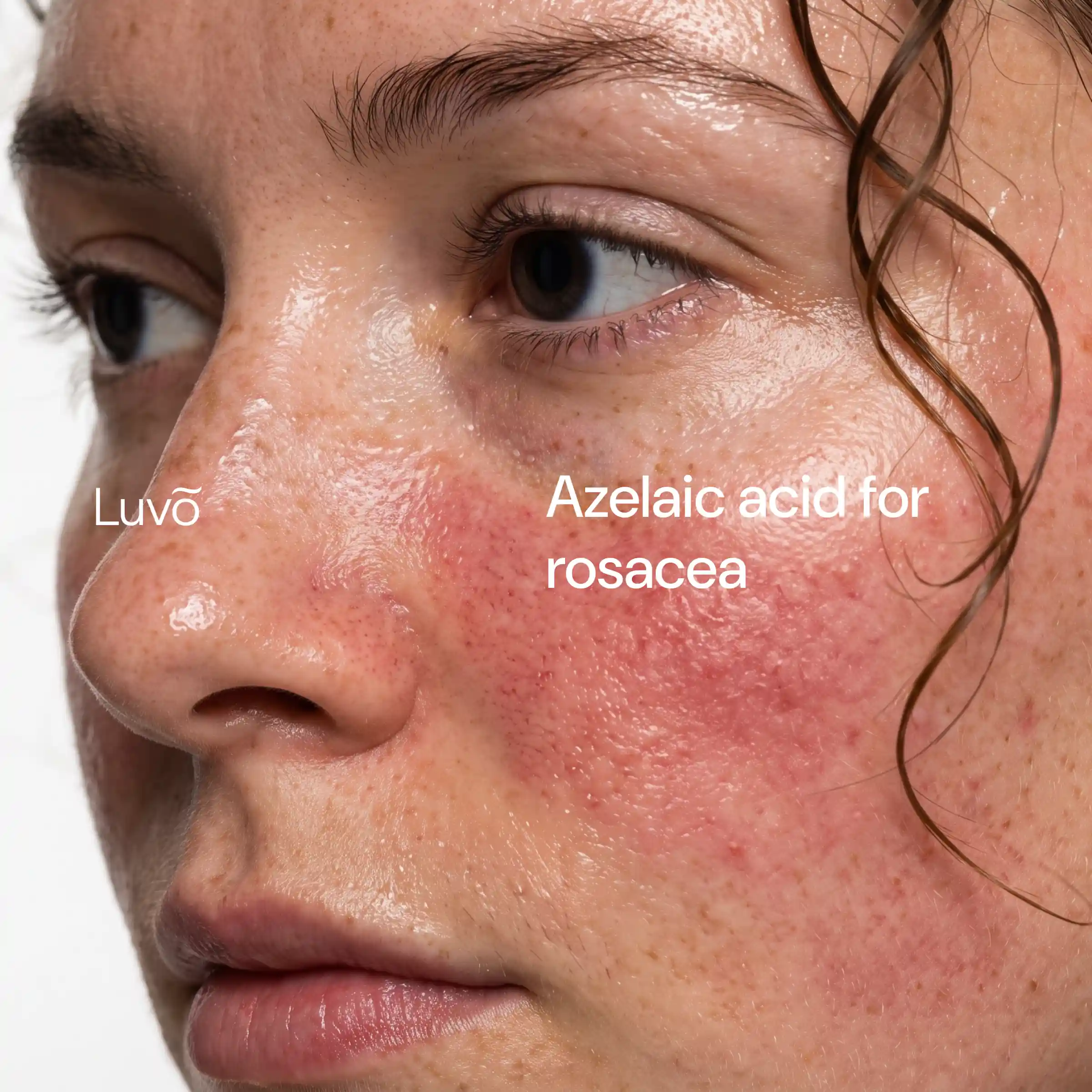
Rosacea is not one condition. Some people mostly have persistent redness and visible blood vessels. Others get inflamed bumps and pimples, called papulopustular rosacea. Azelaic acid is labeled for the second type. This article explains what azelaic acid is approved for, what the evidence shows, what to expect in the first weeks, and why some prescription formulas combine it with metronidazole and ivermectin. It is educational, not medical advice. If you are not sure which type you have, start with Rosacea treatment: redness vs inflammation.
Azelaic acid 15% gel is approved for topical treatment of the inflammatory papules and pustules of mild to moderate rosacea [1]. In clinical studies, some reduction in redness was seen in people who also had bumps and pimples, but the label says effectiveness for redness without papules and pustules has not been evaluated [1].
The label also states that the exact way azelaic acid works against rosacea is not known [1]. What is known is that it works better than an inactive gel. A Cochrane review found azelaic acid more effective than placebo for papulopustular rosacea and rated that evidence high quality [2].
The label lists several things to know [1]:
These are not comprehensive lists of risks or contraindications; patients should review the prescribing information and discuss their medical history with their clinician.
If irritation is strong or does not ease, tell your provider rather than stopping and starting on your own.
Metronidazole 1% gel is approved for topical treatment of the inflammatory lesions of rosacea [3]. Like azelaic acid, its exact mechanism in rosacea is unknown [3]. In the label's main trial, people applied it once daily for 10 weeks [3]. The Cochrane review found metronidazole more effective than placebo for papulopustular rosacea, with moderate-quality evidence [2].
Ivermectin 1% cream is approved for the inflammatory lesions of rosacea [4]. In clinical trials, the most common side effects were skin burning and skin irritation, each reported in 1% of users or fewer [4]. The label says its mechanism in rosacea is unknown [4]. The Cochrane review found high-quality evidence that topical ivermectin works better than placebo [2].
Because rosacea varies and each ingredient is approved for inflammatory lesions on its own, some clinicians prescribe multi-ingredient compounded formulas. A licensed compounding pharmacy prepares these formulas. Luvo does not. Compounded formulas are not FDA-approved, and combinations are not approved as combinations.
We did not find trials of a three-ingredient formula of azelaic acid, metronidazole, and ivermectin, so whether such a combination does more than any single ingredient has not been established. The FDA approvals and studies described in this article apply to single-ingredient products, not to compounded formulas.
For inflammatory rosacea, a provider may consider a compounded formula such as Rosacea Formula: Inflammation. The prescribing provider decides whether it fits you and which active ingredients and strengths are appropriate.
Persistent background redness and visible blood vessels are a different problem. The azelaic acid label does not support it for redness without bumps [1]. If redness is your main concern, a provider may look at other approaches. See the Rosacea Formula: Sensitive page and how Luvo skincare works.
Like any prescription treatment, these ingredients carry possible side effects, and your provider will review them with you. Everyday habits matter too:
See a provider promptly if rosacea affects your eyes, if your skin worsens on treatment, or if you develop a rash or swelling.
Is over-the-counter azelaic acid the same as prescription?
They are not interchangeable. Prescription azelaic acid for rosacea is labeled at 15% [1]. Lower-strength cosmetic products are not the approved rosacea treatment and have not been evaluated the same way.
How long before I see improvement?
The metronidazole gel trial measured results after 10 weeks of daily use [3]. Irritation from azelaic acid tends to happen in the first few weeks [1]. Give a new treatment the time your provider recommends before judging it.
Can I use azelaic acid with tretinoin?
The labels we reviewed do not address using them together. Both can irritate skin, so ask your provider before combining them. See Tretinoin: how it works and what to expect.
If any of this sounds like what you are dealing with, the next step is a conversation with a licensed provider who can review your history and decide whether treatment makes sense for you. Nothing is prescribed or shipped without that review. Any medication preference you indicate is only a starting point for discussion. A licensed clinician independently determines whether prescription treatment is medically appropriate and, if so, which medication, dose, and treatment plan are appropriate based on your clinical evaluation.
Explore Luvo's Skincare Program.
This article is for general educational purposes and is not medical advice. It is not a substitute for a conversation with a licensed healthcare provider about your own health. Prescription treatments require provider review and approval. Individual results vary.
Compounded medications are prepared by a licensed compounding pharmacy and are not FDA-approved. The FDA does not evaluate compounded drugs for safety, effectiveness, or quality. Combination formulations are not approved as combinations.
If your symptoms are severe, worsening, or new, contact a healthcare provider. If this is an emergency, call 911 or go to the nearest emergency room.
All brand names are the trademarks of their respective owners. Luvo Health is not affiliated with, endorsed by, or sponsored by any of them.