October 1, 2026
⋅
4
min read


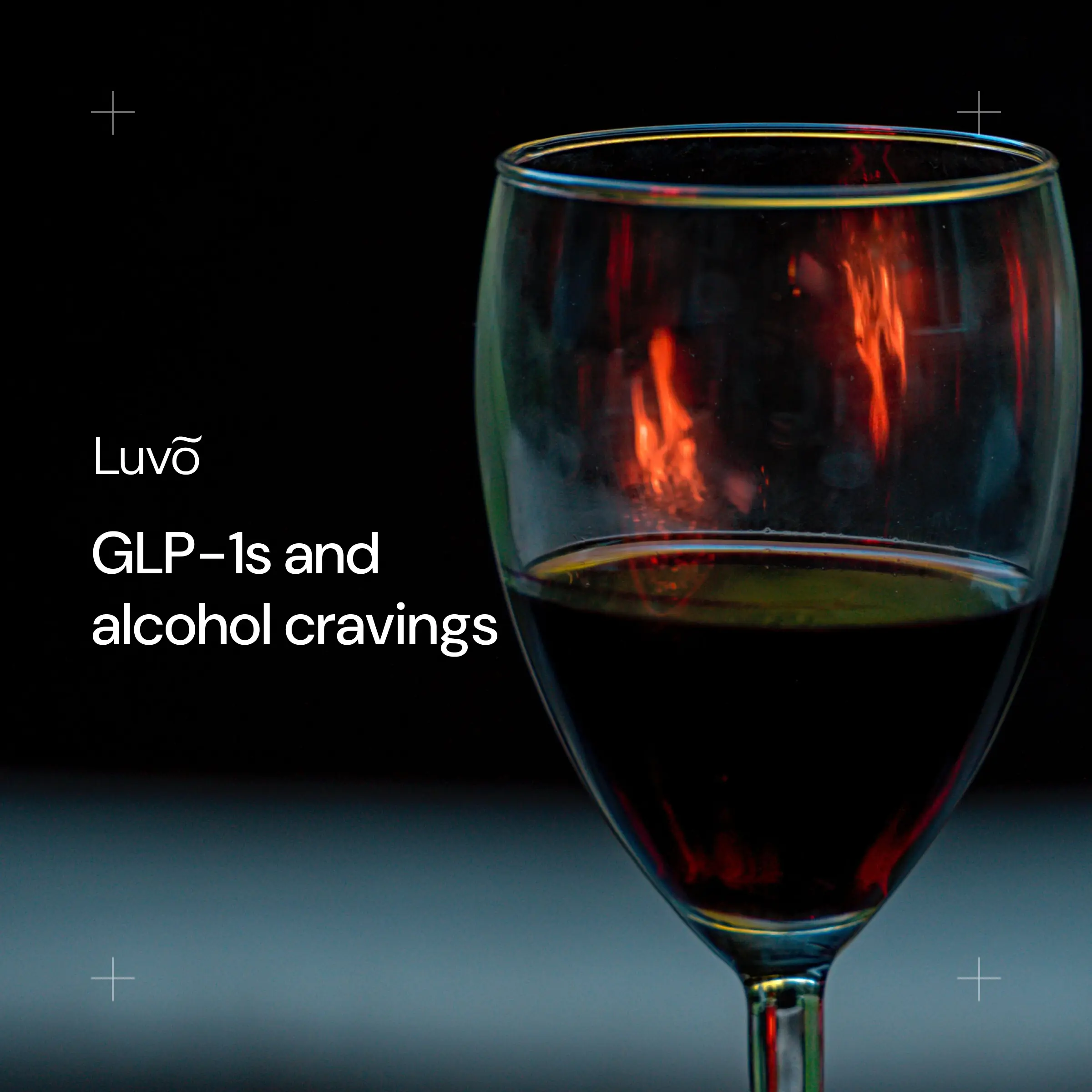
Some people taking GLP-1 medications report that they stop wanting a drink. Not that they decided to cut back, but that the interest quietly went away. Enough people have said this that researchers went looking.
This article covers what that research has found so far, what it does not show, and where the line sits between an observation and a treatment. It is educational and not medical advice.
One thing should be clear at the top. GLP-1 medications are not approved to treat alcohol use disorder. This is not what a licensed provider prescribes them for at Luvo, and nothing below should be read as suggesting otherwise.
Patients commonly report reduced interest in alcohol while taking a GLP-1 medication. Some describe drinking less without trying. Some say a drink stopped being appealing. Some notice they forgot to have one.
Reports like these are where research questions come from, not where answers come from. People notice all sorts of things during a period when their eating, weight, and routines are changing at once. That is precisely why the question went to trials.
GLP-1 is not only a gut hormone. It is synthesized in brainstem neurons and projects to regions involved in reward regulation, including mesocorticolimbic pathways [1]. Those are the same circuits implicated in how alcohol and other substances produce reinforcement.
That gives a plausible biological reason why a GLP-1 receptor agonist might affect alcohol-related behavior rather than only appetite. Preclinical work has reported that GLP-1 receptor agonists reduce voluntary alcohol consumption and attenuate alcohol reinforcement in animal models [2].
Plausible mechanism plus animal data is a reason to run a trial. It is not evidence of a treatment effect in people.
A large real-world analysis reported associations between semaglutide and lower incidence and recurrence of alcohol use disorder diagnoses [3]. Register-based studies have similarly reported lower rates of alcohol-related events among people treated with GLP-1 receptor agonists [1].
Observational findings like these cannot separate the drug from the people taking it. Someone starting a weight management medication is often changing several things at once, and the people who get prescribed one differ from those who do not. These studies generate hypotheses. They do not establish cause.
The first controlled trial in humans was published in JAMA Psychiatry in 2025. It was a phase 2, double-blind, randomized trial of nine weeks of low-dose semaglutide in 48 non-treatment-seeking adults with alcohol use disorder [2].
The results were mixed, and the detail matters more than the headline.
What changed. Semaglutide reduced the amount of alcohol consumed in a laboratory self-administration procedure. It significantly reduced drinks per drinking day and weekly alcohol craving, and predicted greater reductions in heavy drinking over time compared with placebo [2].
What did not change. Semaglutide did not affect average drinks per calendar day, and it did not change the number of drinking versus abstinent days [2]. People did not drink on fewer days. They drank less on the days they drank.
The authors' own conclusion was that these findings provide initial prospective evidence justifying larger trials [2]. Independent commentary noted medium to large effect sizes on the key outcomes but cautioned that the sample was small [2].
Further randomized trials, including in people with alcohol use disorder and co-occurring obesity, have since been conducted and reported, and more are ongoing [4].
This section matters more than the one above it.
GLP-1 medications are not approved for alcohol use disorder anywhere, and no regulator has evaluated them for that use. The existing evidence is one small phase 2 trial plus observational data.
A craving reduction is not a treatment for dependence. Alcohol use disorder involves physical dependence, withdrawal risk, and psychological and social dimensions that a change in craving does not address. Alcohol withdrawal can be medically dangerous, and stopping suddenly is not something to attempt based on an article.
Effective approved treatments already exist, along with behavioral treatment and support programs. Someone who wants help with drinking has real options today, with far more evidence behind them.
The effect is not universal. The trial did not find every outcome improving, and individual responses vary. Plenty of people take these medications and notice nothing about alcohol at all.
This is not why a provider prescribes a GLP-1 at Luvo. These are weight management medications, prescribed after a licensed provider reviews your history for that purpose.
Alcohol is a meaningful source of calories, and people who drink less often find their overall intake changes. If alcohol comes up in a conversation about weight, it is a reasonable thing to discuss with the provider managing your care.
This article does not set targets around drinking or intake, and it is not a plan for either.
If drinking feels hard to control, raise it with a clinician. That is worth doing regardless of whether you take any medication, and regardless of what you have read about GLP-1s.
Also worth raising: if you drink regularly and are starting or already taking a GLP-1 medication. Alcohol can interact with nausea and with blood sugar, and your provider should know what your actual drinking looks like in order to advise you well.
If you are considering reducing or stopping a significant drinking habit, do it with clinical guidance rather than alone. Withdrawal from heavy alcohol use can be serious.
Do GLP-1 medications treat alcoholism?
No. They are not approved for alcohol use disorder, and no regulator has reviewed them for it. The evidence currently consists of one small phase 2 randomized trial with mixed results [2], observational associations [3], and animal studies [1, 2]. Researchers are studying the question. That is the accurate description of where things stand.
Why might cravings drop?
The working hypothesis is that GLP-1 acts on brain reward pathways, not just appetite pathways. GLP-1 is produced in brainstem neurons that project to reward-regulating regions [1]. This is a hypothesis supported by preclinical work and early human data, not a settled mechanism.
Is this effect universal?
No. In the randomized trial, some drinking measures changed and others did not: drinks per drinking day and craving fell, while the number of drinking days did not [2]. Individual results vary, and many people notice no change at all.
Should I mention my drinking to my provider?
Yes, and honestly. It affects how a medication may be tolerated, and it is information a provider needs in order to give you useful advice. Providers ask about alcohol to treat you properly, not to judge you.
If any of this sounds like what you are dealing with, the next step is a conversation with a licensed provider who can review your history and decide whether treatment makes sense for you. Nothing is prescribed or shipped without that review.
Explore Luvo's Weight Loss Program.
This article is for general educational purposes and is not medical advice. It is not a substitute for a conversation with a licensed healthcare provider about your own health. Prescription treatments require provider review and approval. Individual results vary.
GLP-1 medications are not approved for the treatment of alcohol use disorder. The research described here is investigational and does not reflect an approved use.
Compounded medications are prepared by a licensed compounding pharmacy and are not FDA-approved. The FDA does not evaluate compounded drugs for safety, effectiveness, or quality.
If your symptoms are severe, worsening, or new, contact a healthcare provider. If this is an emergency, call 911 or go to the nearest emergency room.
This article does not provide calorie, macronutrient, or portion targets. If tracking food or restricting intake causes you distress, bring it up with a clinician before making changes.
All brand names are the trademarks of their respective owners. Luvo Health is not affiliated with, endorsed by, or sponsored by any of them.






.webp)
.webp)