

September 17, 2026
⋅
5
min read


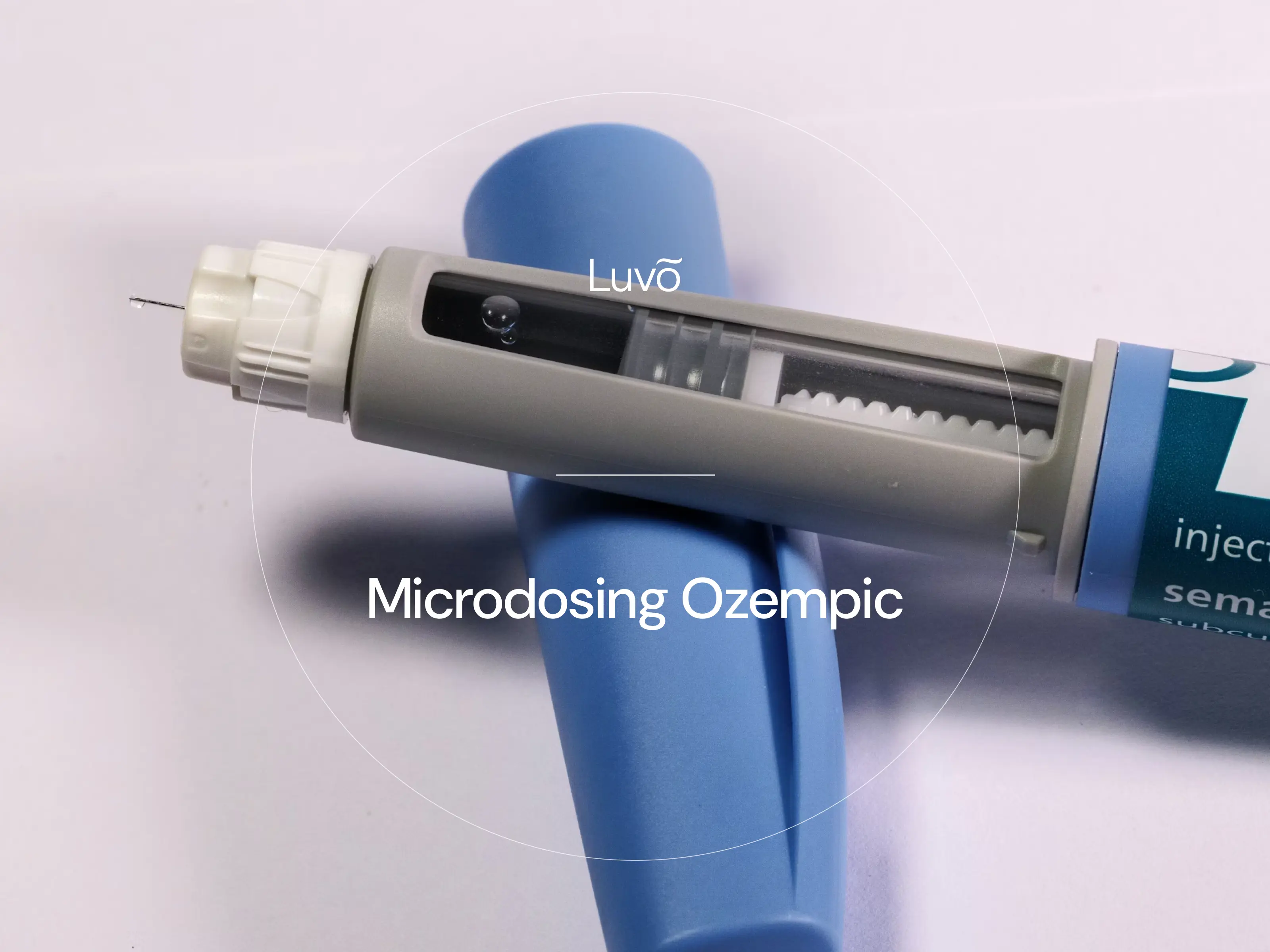
"Microdosing Ozempic" is one of the most-searched phrases around GLP-1 medications, but it describes something Ozempic itself was never built to do. This article explains what people actually mean by the phrase, why an official Ozempic microdosing protocol doesn't exist, and where the flexible, low-dose approach people are looking for actually lives.
Ozempic is a brand name, owned by Novo Nordisk, for the medication semaglutide. It is FDA-approved for adults with type 2 diabetes, not for weight loss, although some providers prescribe it off-label for that purpose. When people search "microdosing Ozempic," they're almost never asking about the Ozempic brand specifically. They're asking whether semaglutide, the active ingredient, can be taken at doses lower than a standard starting dose, in a more flexible or gradual way than the brand pen allows. The brand name is doing the work of describing the ingredient, the way "Kleenex" gets used for tissues.
If you want the full picture of what microdosing semaglutide means as a general approach, including how it's typically structured and what it isn't, our complete guide to microdosing semaglutide covers that ground. This article has a narrower job: answering the specific "Ozempic" version of that search, and explaining why the brand pen and the flexible, provider-directed low-dose approach are two different things wearing the same search term.
Ozempic's FDA-approved label sets fixed doses: 0.25 mg to start, stepping up to 0.5 mg, then optionally 1 mg and 2 mg, delivered through a pre-filled pen with a dial that only clicks to those specific amounts [1]. There is no approved Ozempic dose below 0.25 mg, and the pen mechanism is not designed to dispense anything in between its labeled click-stops [1]. In that sense, "Ozempic microdosing" as an official, branded protocol simply doesn't exist, because the product wasn't built to deliver doses outside that fixed schedule.
Compounded semaglutide is different. Because it's prepared to order by a licensed compounding pharmacy rather than manufactured in a fixed-dose pen, it can be formulated across a wider range of doses, including amounts smaller than a standard starting dose. That flexibility is where a genuinely lower-dose, more gradual approach becomes possible, under a provider's direction. Compounded semaglutide contains the same active ingredient studied in FDA-approved products, but it is a compounded formulation, not an approved drug, and it has not been evaluated by the FDA for safety, effectiveness, or quality.
A provider-directed lower-dose approach isn't something you calculate or adjust on your own. It typically follows a structure like this:
Nothing here is a substitute for that process. A provider determines whether this approach fits you, what dose to start at, and how to adjust it.
A lower-dose, more gradual approach is sometimes discussed for people who are especially sensitive to gastrointestinal side effects, or who want a slower introduction to a GLP-1 medication before considering a standard dose. It is not established as more effective, safer, or a better fit for weight-related goals than a standard approach, and it isn't right for everyone. Whether it's appropriate for you depends on your health history and goals, which is a conversation for your provider, not a promise this article can make.
The practical difference comes down to how each product is made and dosed:
This is a difference in how each product is manufactured and dosed, not a claim that one is equivalent to, a substitute for, or a lesser or better version of the other.
Do not try to divide, split, or measure a partial dose from an Ozempic pen on your own. The pen's dial is engineered to stop only at its labeled doses for a reason, and drawing or estimating an amount outside that design was not how the product was studied or approved. This isn't a small caution: the FDA has specifically warned that it has received adverse event reports, some requiring hospitalization, linked to patients measuring and self-administering incorrect doses of semaglutide products, particularly compounded ones dispensed in vials rather than pre-filled pens [2]. If you want a dose outside what a brand pen offers, that is a conversation to have with a licensed provider, not something to attempt with a syringe at home.
Is microdosing Ozempic safe?
There's no dedicated safety data for "microdosing" the Ozempic brand specifically, because the brand doesn't offer doses below its labeled starting amount. A provider-directed lower dose of compounded semaglutide is a different scenario, and its safety for you specifically is something your provider assesses based on your health history, not something this article can determine in general terms.
Can I split my Ozempic pen doses myself to microdose?
No. The pen is designed to dispense only its labeled doses, and self-splitting or estimating a smaller amount isn't how the product is meant to be used. The FDA has linked this kind of self-measured dosing to real adverse events [2]. If a lower dose is something you want to explore, raise it with a licensed provider instead.
Is a lower-dose approach cheaper?
It can be, depending on the pharmacy and program, since a lower dose typically uses less medication per fill. Pricing varies by provider and pharmacy, so this isn't something to assume without checking directly.
Does a lower dose mean fewer side effects?
Some published pharmacology suggests side effects like nausea are often dose-related during the early escalation period of GLP-1 treatment, and that starting lower can ease that adjustment for some people [1]. That is different from claiming a lower dose guarantees fewer side effects or better tolerability for everyone. Individual response varies, and your provider is the one who can speak to your situation specifically.
If you're trying to figure out whether a lower-dose, more gradual approach to semaglutide makes sense for you, the next step is a conversation with a licensed provider who can review your history and help you decide. Nothing is prescribed or shipped without that review.
Explore Luvo's Microdosing Program.
This article is for general educational purposes and is not medical advice. It is not a substitute for a conversation with a licensed healthcare provider about your own health. Prescription treatments require provider review and approval. Individual results vary.
Compounded medications are prepared by a licensed compounding pharmacy and are not FDA-approved. The FDA does not evaluate compounded drugs for safety, effectiveness, or quality. Combination formulations are not approved as combinations.
All brand names are the trademarks of their respective owners. Luvo Health is not affiliated with, endorsed by, or sponsored by any of them.




.webp)



.webp)