

September 15, 2026
⋅
5
min read
Sermorelin dosage: What labels and studies actually say
Written by:

Eland Siddle, Pharm.D.
Reviewed by:
Eland Siddle, Pharm.D.


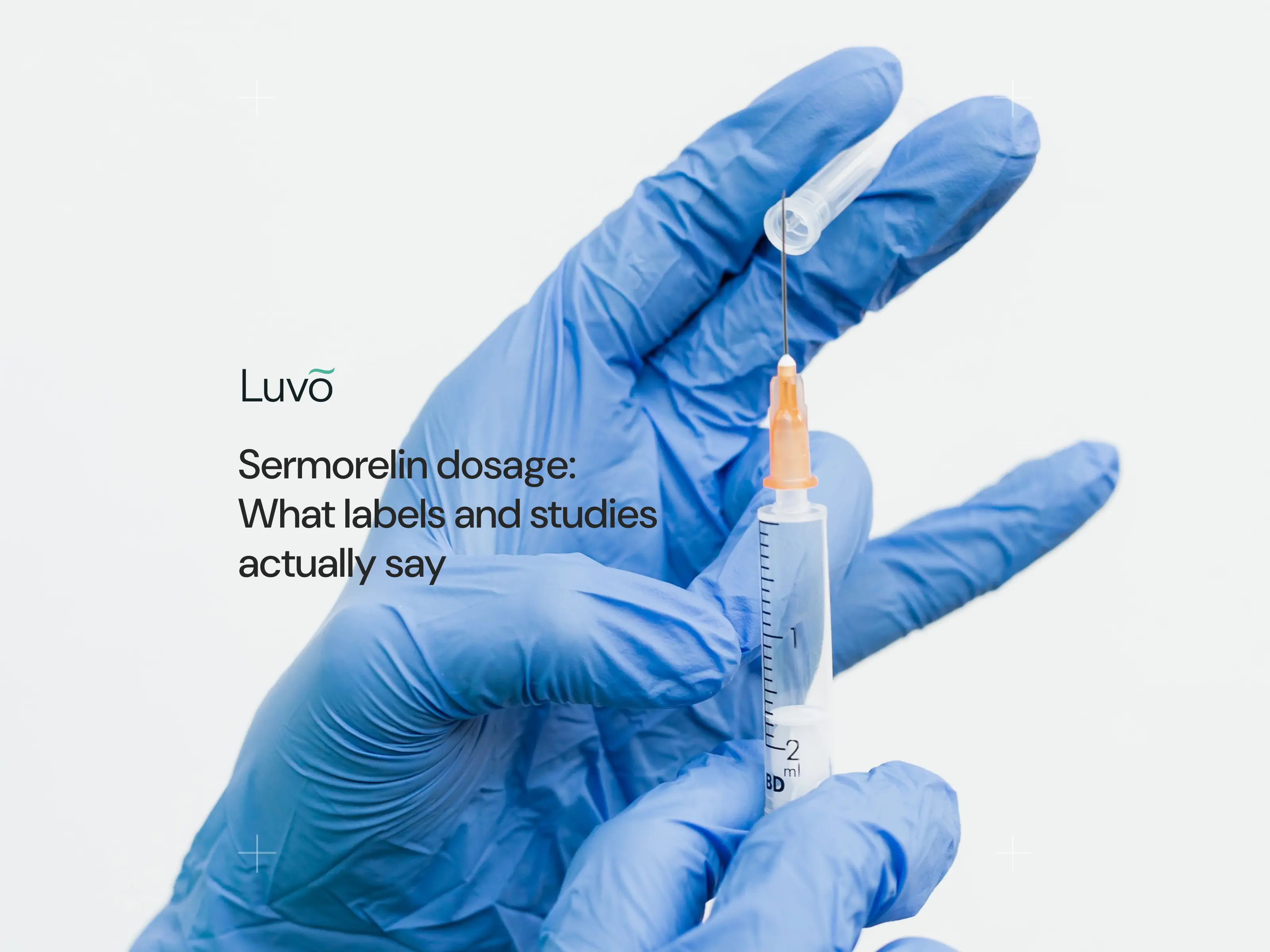
Your dose is not something you calculate at home. A licensed provider determines it, based on your health history, and adjusts it over time based on how you respond. What follows is an overview of what published labeling and clinical research report about sermorelin dosing. It is general information, not a protocol to follow on your own.
Sermorelin is a growth hormone-releasing hormone (GHRH) analog: a short chain that mimics the first part of the body's own GHRH and signals the pituitary gland to release growth hormone. It does not supply growth hormone directly.
The only dose that ever carried FDA approval was weight-based and pediatric. The Geref label, approved in 1997 for children with documented growth hormone deficiency, specified 30 micrograms per kilogram of body weight, injected subcutaneously once daily at bedtime [1]. A separate diagnostic formulation used a single 1 microgram per kilogram intravenous bolus to test pituitary responsiveness in a clinical setting [1]. Both products were voluntarily withdrawn from the US market in 2008 for commercial reasons, not safety, and neither is available today outside a compounding pharmacy [1].
Adult dosing has never gone through that same FDA review process, so the numbers that exist come from smaller published studies rather than an approved label. In one study of 11 healthy men aged 64 to 76, researchers gave 2 milligrams of subcutaneous sermorelin nightly for 6 weeks and measured growth hormone output over 12-hour windows [2]. In an earlier study, older men received 0.5 to 1 milligram twice daily [2]. These figures describe what was studied, not a dose any given adult should expect a provider to choose. Adult dosing in current clinical use rests far more on practitioner judgment and published pharmacokinetic data than on a settled RCT record [2].
Any dose mentioned here, including the ones above, is general information about what has been labeled or studied. It is not a recommendation, and your provider determines what, if anything, is appropriate for you.
Sermorelin is given by subcutaneous injection, typically into the abdomen, thigh, or upper arm, with injection sites rotated over time. The historical Geref label specifically called for once-daily dosing at bedtime [1].
The timing has a physiologic rationale. Growth hormone is released from the pituitary in discrete pulses, and the largest of those pulses normally occurs during the early, deep stages of nighttime sleep. A short-acting GHRH analog given around that window is intended to align with that naturally occurring pulse rather than work against it. Published pharmacokinetic data on sermorelin in humans are actually limited. A widely cited academic overview notes that no dedicated human pharmacokinetic study has been published, and that the closest available half-life estimate, roughly 6 minutes, comes from intravenous dosing in rats, not people [3]. Other secondary sources report a human half-life in the 10-to-20-minute range, but that figure is not traceable to a published human PK study. Either way, sermorelin clears the bloodstream quickly, which is part of why timing relative to the body's own GH pulse matters more than it might for a longer-acting medication.
In clinical practice generally, a provider starting a patient on a GHRH analog like sermorelin typically begins at a conservative dose and adjusts based on tolerance and response over subsequent visits, rather than starting at a fixed target dose. Adjustments are a clinical decision made over time, not a one-time calculation.
At Luvo, this looks like a short re-questionnaire roughly every four weeks. Your provider reviews it and decides whether to continue, adjust, or change your plan. You do not set or change your own dose between those check-ins.
A provider weighing sermorelin dosing may consider several factors, though none of these guarantee a particular outcome:
This list describes inputs to a clinical decision. It is not a promise about how any individual will respond, and results are not guaranteed.
Published sources do not offer a current, sermorelin-specific missed-dose protocol, since the approved label was withdrawn in 2008 and current use is off-label. As a general practice with daily self-injected medications, a missed dose is typically not doubled up to catch up. Ask your provider or pharmacy for guidance specific to your prescription.
On exceeding the recommended dose, the historical Geref label was direct: the recommended dosage should not be exceeded [4]. That label also documented injection-site pain, redness, swelling, facial flushing, headache, nausea, and other reactions when sermorelin was given at labeled doses [4]. Like any prescription medication, sermorelin carries possible side effects, and a provider is the right person to walk through what to watch for and when to reach out. If you ever suspect you or someone else has taken significantly more than intended, contact your provider, a pharmacist, or poison control promptly.
Can I adjust my own dose?
No. Dosing decisions, including any change up or down, are made by your provider based on your history and how you are responding. Self-adjusting outside that review is not something this article can support.
How long does a provider typically wait before changing a dose?
This varies by provider and individual case. In a subscription model like Luvo's, the standard rhythm is a check-in roughly every four weeks, at which point your provider reviews how things are going and decides whether to hold the current dose or adjust it.
Does a higher dose mean faster results?
There is no published data establishing that a higher sermorelin dose produces faster or better outcomes, and this article makes no such claim. Dosing is an individualized clinical decision, not a dial that predictably speeds up results.
What if I miss a dose?
Contact your provider or pharmacy for guidance specific to your prescription rather than guessing. As a general rule with daily injectable medications, missed doses are not typically doubled up to compensate.
If you are trying to understand what a realistic sermorelin dose might look like for you, the next step is a conversation with a licensed provider who can review your health history and make that determination directly. Nothing is prescribed or shipped without that review, and any bloodwork used to guide dosing is arranged through your own physician, not this article.
Explore Luvo's Longevity Program.
This article is for general educational purposes and is not medical advice. It is not a substitute for a conversation with a licensed healthcare provider about your own health. Prescription treatments require provider review and approval. Individual results vary.
Compounded medications are prepared by a licensed compounding pharmacy and are not FDA-approved. The FDA does not evaluate compounded drugs for safety, effectiveness, or quality. Combination formulations are not approved as combinations.
All brand names are the trademarks of their respective owners. Luvo Health is not affiliated with, endorsed by, or sponsored by any of them.





.webp)

.webp)
.webp)
.webp)


.webp)
.webp)